The evidence behind Neta
How Neta decides what to tell you, what it does when it doesn't know yet, and the sources it cites.
The new name, and where it comes from
In May 2026, after a multistep international consensus process, The Lancet published the official rename: PCOS is now also called PMOS (Polyendocrine Metabolic Ovarian Syndrome).1
Read the full articleNeta tells you what it doesn't know about you.
Most apps promise answers on day one. Neta shows you where every answer comes from, and the line between the field's evidence and yours moves as you log.
Day one: mostly the field, and Neta says so.
Before your first log there is already a reading, built from published research on bodies like yours and labeled as exactly that. Nothing pretends to be about you before it is.
Every log visibly moves the reading.
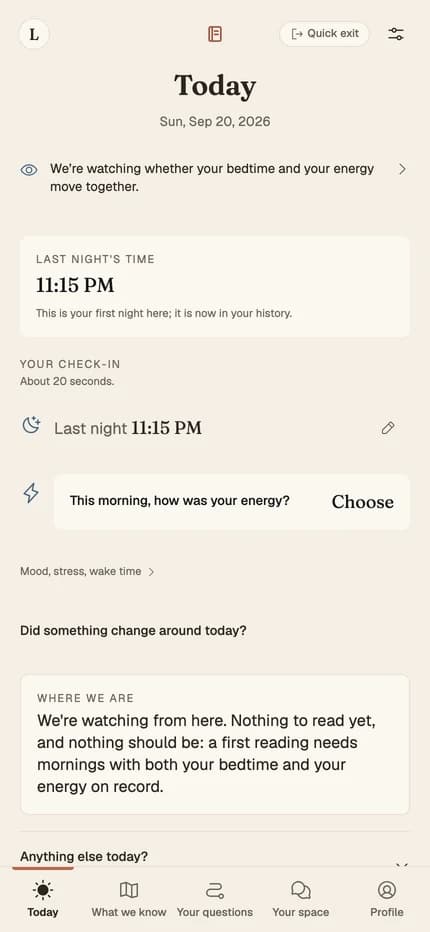
Each thing you record shifts what Neta can say about you, and you can watch the shift: how much of an answer rests on research, and how much on your own data. You log your bleeding; the rest is worked out from there.
When Neta doesn't know yet
"No consistent relationship" is an answer.
When your data shows no link between two things you wondered about, Neta says that, plainly. A clear no closes a question and saves you a month of chasing it.
See the reasoning for yourself
Every question Neta studies answers "Why?" in five parts, including what is uncertain and what the research has not measured. This is the real panel for its first question, your bedtime and next-day energy, exactly as it renders in the app.
Does your bedtime move with your energy the next morning?
What the research says
Later nights, less energy the next day: the direction is known, not yet how much.
What is uncertain
Every study Neta found measured how long or how well women slept. None measured what time they fell asleep, which is what you log, and none was in women with PMOS. The populations were older adults, adolescents and shift-working nurses.
Why this is observable
Both sides of this are already in your record: Bedtime · Energy. Nothing here asks a new habit of you.
Why it matters to your question
It is the pair with the longest-standing evidence summary, and the one your first observations were collected for. That is why it goes first, not because it is the most likely to matter for you.
What would change this
Contrast: days unlike your usual in one respect, your bedtime. More days that resemble each other add to the record without adding contrast, and contrast is what this turns on.
What this rests on
- Nakagawa T, Yasumoto S, Kabayama M, et al. Association between prior-night sleep and next-day fatigue in older adults: a daily diary study. BMC Geriatr. 2023;23(1):817. doi:10.1186/s12877-023-04539-0
- Shen L, Nicolazzo J, Sletten TL, Anderson C, Yap Y, Wiley JF, Bei B. Daily fluctuations in adolescents' sleep predict next-day attention, sleepiness, and fatigue: an ecological momentary assessment study over 28 days. J Child Psychol Psychiatry. 2025;66(5):686-96. doi:10.1111/jcpp.14076
- Slavish DC, Dietch JR, Kane HS, et al. Daily stress and sleep associations vary by work schedule: A between- and within-person analysis in nurses. J Sleep Res. 2022;31(3):e13506. doi:10.1111/jsr.13506
Your question, your record, what Neta learns
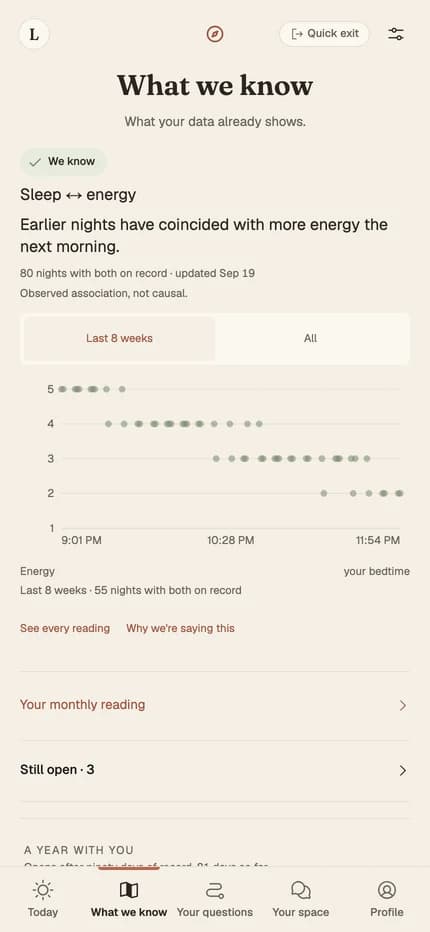
Real screens with an example account. The finding uses simulated history; it is not an immediate result.
1 · You ask your question
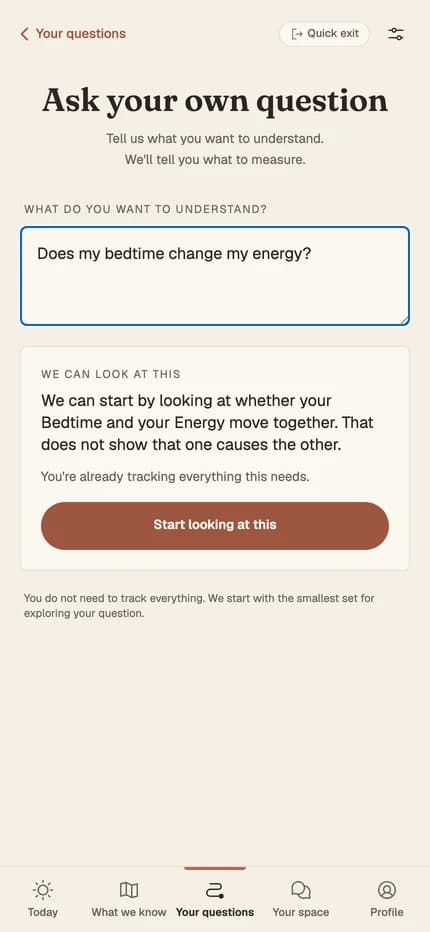
2 · Neta chooses the minimum to observe
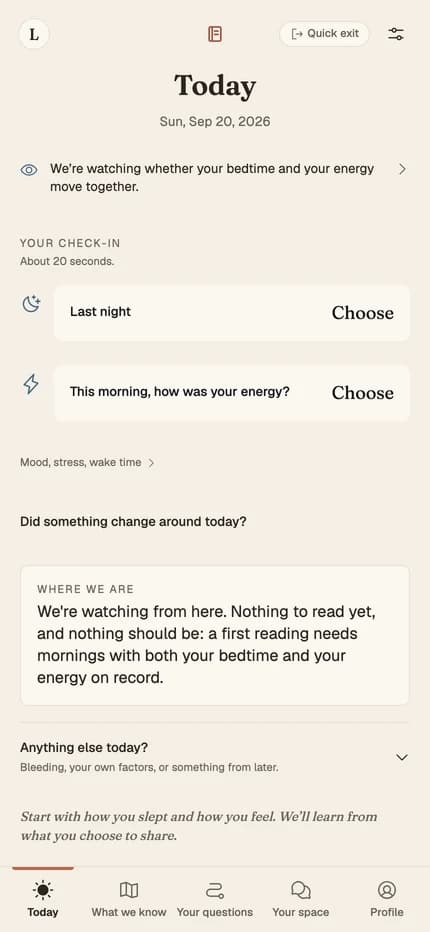
3 · Every record gives something back
4 · Neta shows what your data supports
Peer-reviewed sources behind every research claim
No supplement kickbacks. Ever.
Sources
- Teede HJ et al. Polyendocrine metabolic ovarian syndrome, the new name for polycystic ovary syndrome: a multistep global consensus process. The Lancet. 2026. DOI: 10.1016/S0140-6736(26)00717-8
- Bozdag G, Mumusoglu S, Zengin D, Karabulut E, Yildiz BO. The prevalence and phenotypic features of polycystic ovary syndrome: a systematic review and meta-analysis. Human Reproduction. 2016;31(12):2841-2855
- Briden L. Period Repair Manual: Natural Treatment for Better Hormones and Better Periods. 2nd edition (Ch. 7-8). Pan Macmillan, 2017. ISBN 978-1976159480
- Mousa A et al. International PCOS guideline clinical research priorities roadmap. eClinicalMedicine (The Lancet). 2024
- Moran C, Tena G, Moran S, Ruiz P, Reyna R, Duque X. Prevalence of Polycystic Ovary Syndrome and Related Disorders in Mexican Women. Gynecologic and Obstetric Investigation. 2010;69(4):274-280. Found 6.0% (NIH criteria) and 6.6% (Rotterdam) in 150 Mexican women aged 20-45, below the global figure, not above it. Neta previously cited a 21-22% Mexican prevalence attributed to INPer; that figure is a health-authority statement whose population and diagnostic criteria are not published, and it disagrees with the only peer-reviewed Mexican measurement that could be found, so no Mexico-specific prevalence claim is made any more.
- Polycystic Ovarian Syndrome, Dietary Supplements, and TikTok: A Balanced Supplement Stew or Everything But the Kitchen Sink? Fertility and Sterility. 2024
- Teede HJ et al. Recommendations From the 2023 International Evidence-based Guideline for the Assessment and Management of Polycystic Ovary Syndrome. The Journal of Clinical Endocrinology & Metabolism. 2023;108(10):2447-2469. DOI: 10.1210/clinem/dgad463